
How to Clean a 9mm Pistol: Complete Guide
The 9mm is the cartridge US shooters fire the most of, and that volume is why it needs its own routine: a hundred rounds of practice ammunition leaves carbon in the chamber, copper and lead in the bore, and grit on the rails — none of which announces itself until feeding or accuracy drifts. Here is the sequence the owner's manuals specify.
The cartridge sets the rules
SAAMI — the Sporting Arms and Ammunition Manufacturers' Institute, founded in 1926 — standardises the cartridge and publishes its drawings under the name 9mm Luger, with a maximum average pressure of 35,000 psi (38,500 psi for +P). That number is why chamber condition matters: the 9mm is a rimless, tapered case that headspaces on the case mouth, so the front of the chamber both seals 35,000 psi of gas and positions the round for the firing pin. Keep it clean and the pistol keeps running.
The bullet is .355 in / 9.0 mm — the number to remember when buying a jag, brush or patch, because 9mm, .38 Special and .357 Magnum all fall within a few thousandths of an inch and share one tool size.
What the manuals actually specify
Smith & Wesson's M&P manual lists what a usable kit contains: "a brass bore brush and a cleaning jag of appropriate size for the bore being cleaned, high-quality gun cleaning solvent and gun oil/lubricant, cotton cleaning patches and a cleaning rod that is long enough to push the brush and jag completely through the barrel." It adds two points shooters skip. A new pistol ships behind "either a preservative or oil to protect it against corrosion during shipping and storage", and that coating should come off the bore and chamber before the first shot. And "whenever your firearm has been exposed to sand, dust, extreme humidity, water or other adverse conditions, it must be cleaned and lubricated" — a rule that matters more than round count on a carry gun.
Beretta's 92FS manual adds the field technique — CLP-wet brush from the chamber end, then patches until they emerge clean — and the step almost everyone skips: "recheck the chamber and bore for possible gunpowder residue sweat-out a few days after the shooting/cleaning."
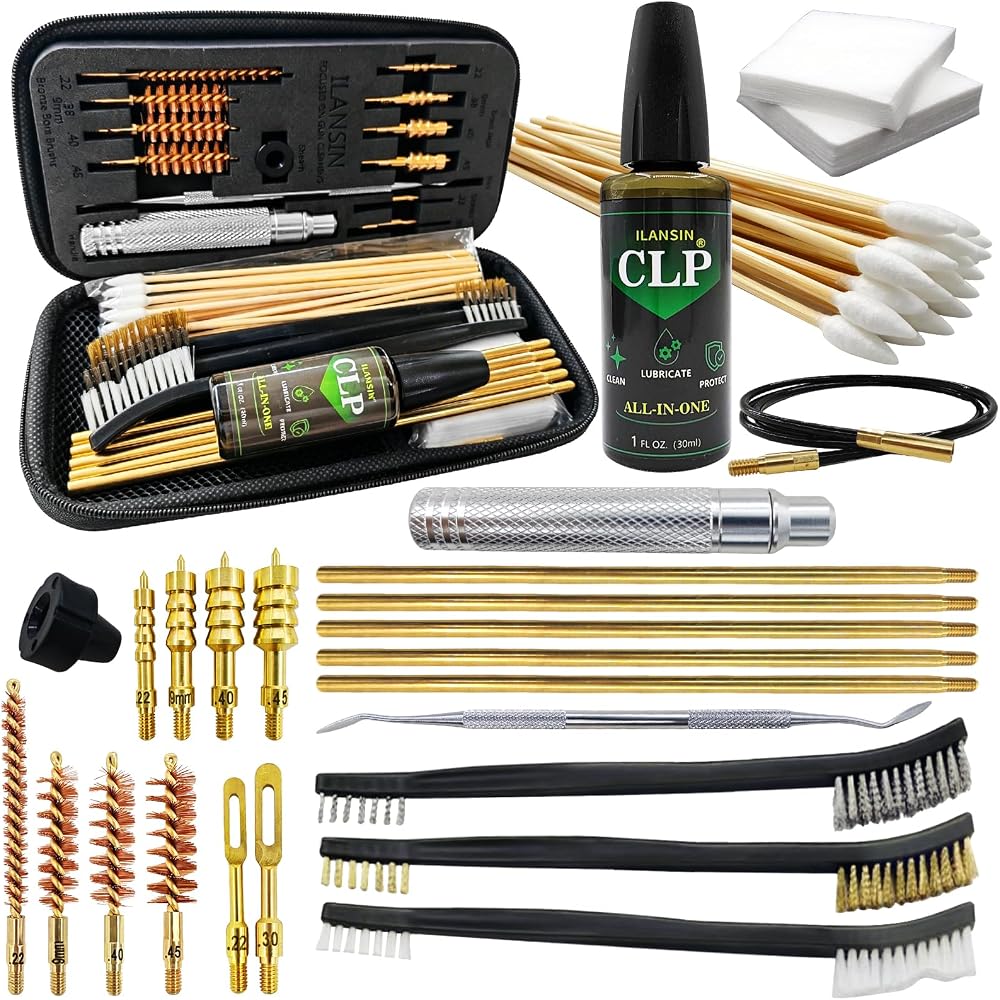
A caliber-matched rod, jag and brass brush set — the starting point the manuals assume you have.
How to clean a 9mm pistol, step by step
- Clear it and suit up. Drop the magazine, lock the slide back and check the chamber twice. Glasses and gloves go on before you touch solvent.
- Field strip only as far as the manual allows. Remove the slide, recoil spring and barrel. Smith & Wesson is blunt about the limit: "Never disassemble your firearm beyond the instructions in the Field Stripping and Inspection sections of this manual."
- Wet-brush the bore from the chamber end. Wet a correctly sized brush with solvent and scrub from the chamber end. Beretta's 92FS manual: "Insert the brush into the barrel from the chamber and scrub chamber and bore thoroughly." Entering at the muzzle risks the crown.
- Patch until clean, then dry. Push wetted cotton patches through in one direction, changing them until they come out clean, then finish with dry ones. A short 9mm barrel usually takes three to five.
- Detail chamber, feed ramp and breech face. These govern feeding and extraction, and carbon hides there. Use pointed swabs on the ramp and extractor hook, a soft brush on the breech face. A chamber ringed with hardened carbon is a reliability problem, not a cosmetic one.
- Slide, frame and rails. Wipe the slide interior and frame with a lightly oiled cloth, then wipe dry. Solvent left in the striker or firing-pin area attracts grit.
- Lubricate sparingly. A thin film on the rails, barrel hood and locking surfaces is enough. Smith & Wesson warns that excess lubricant "can collect large quantities of unburned powder and residue, which could interfere with proper functioning."
- Reassemble, function-check, wipe down. Reassemble, cycle the slide on an empty chamber, confirm the trigger resets and the safety works, then wipe the exterior with a silicone-treated cloth — sweat starts on the finish immediately.
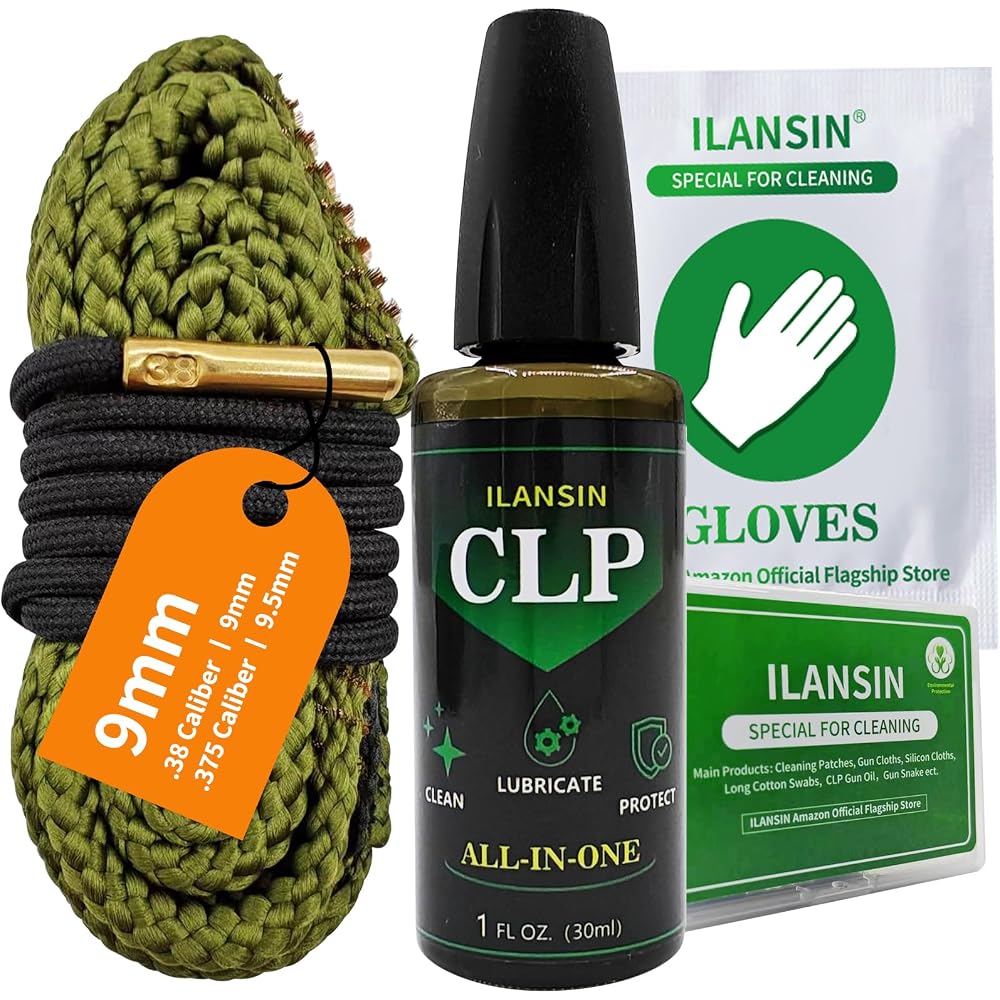
A dedicated 9mm bore cleaner plus CLP covers the wet-brush and lubrication steps in one pass.
Match the patch, jag and brush to the bore
Sizing errors cause most of the damage shooters blame on cleaning. Ruger states the rule plainly — "Use correct size patches and brushes. Larger sizes will bind in the bore" — and it applies to the jag and rod too, which must be long enough to push the brush completely through rather than reverse it inside the barrel. Buy a 9mm / .38 / .357 jag and brush and patches sized for that bore; a patch that has to be forced is too big.

Pointed swabs reach the feed ramp and extractor hook that patches never touch.
The recheck most shooters skip
Beretta's instruction to look at the chamber again a few days later is not busywork: solvent lifts fouling out of the pores of the steel, so residue that looked gone can seep back to the surface. A quick look with a light — and one dry patch if you see anything — is the difference between clean and cosmetically clean.
Lead and solvent safety
Cleaning is a lead-exposure activity, not just a chemical one. Lead from primers and bullets collects in the bore, on patches and on the bench. CDC/NIOSH guidance for shooters and cleaners: do not eat, drink or smoke while working; wash hands and face afterwards; change out of range clothes before getting into a car. Ventilate, wear glasses and gloves, and keep chemicals away from children and pets.
What to keep on the bench
Most of the routine is consumables you will reorder: bulk 100% cotton patches, a bottle of CLP with a needle applicator for the rails, and pointed swabs for the feed ramp. The durable side is smaller — a caliber-matched 9mm pistol kit with the right jag and brush, a dedicated .38 cal / 9mm bore cleaner for heavy carbon, a cleaning mat so pins and springs stay on the bench, and a silicone-treated cloth for the final wipe-down. New to the process? Start with the beginner's first-clean walkthrough, and use our cleaning schedule by use case to decide how often to repeat it.
Buying for a store, a range or your own brand?
Every product above is manufactured on our own line and available wholesale — mixed-SKU cartons, private label from 500 pcs, and single-unit samples on Amazon if you want to test the product first.
Wholesale & Distribution →OEM / ODM →
Or order a single sample to see the quality first.
Sources
- SAAMI — Sporting Arms and Ammunition Manufacturers' Institute (9mm Luger designation, cartridge & chamber standards, founding 1926): saami.org
- Smith & Wesson — M&P pistol safety & instruction manual (cleaning kit contents, factory preservative, adverse-condition cleaning, over-lubrication warning, field stripping limits): smith-wesson.com (PDF)
- Beretta — Model 92FS/92FS Compact operating instructions, cleaning and lubrication (CLP wet-brush from the chamber end, patch until clean, residue "sweat-out" recheck): Beretta 92FS operating instructions
- Ruger — owner's manuals (patch and brush sizing; bore binding): ruger.com
- CDC / NIOSH — Preventing Occupational Exposures to Lead and Noise at Indoor Firing Ranges (hygiene, gloves, ventilation, wash-up): cdc.gov/niosh
Manufacturer and standards guidance is quoted briefly and attributed above; the step-by-step wording is our own summary. Always follow the owner's manual for your specific firearm. Cleaning chemicals and lead residue require ventilation, gloves and eye protection — wash up before eating, drinking or handling food.