
How Often Should You Clean Your Firearm? A Practical Schedule
"How often should I clean my gun?" is the first question every new owner asks, and no manufacturer answers it with a single number — because the right interval depends on how the firearm is used, not on a countdown timer. What the manuals do publish is a set of conditions. Here they are, and the schedule they add up to.
What the manuals actually say
Pistol manuals are the most specific. GLOCK's care guidance says a pistol should be "cleaned and lubricated … [a]t least once a month, if it hasn't been used in that time" — a calendar rule, not a round count — and its instruction manual lists the same triggers in sequence: "when brand new, before first time it is fired", after each firing, and "at least once a year" regardless. GLOCK also expects a field strip for cleaning rather than a rod run in from the muzzle.
SIG SAUER's P320 manual takes the usage-based route: "Clean and lube before or after every day the pistol is fired or at a minimum of every 500 rounds." Ruger tells LCP MAX owners to "clean and inspect your firearm after each range session or whenever the pistol has been exposed to sand, dust, moisture, humidity", and its AR-556 manual repeats the rule for rifles: "After each shooting session, at regular intervals, or whenever the rifle has been exposed to sand, dust, extreme humidity, condensation, immersion in water".
Ruger's No. 1 rifle manual states the principle most cleanly: "There is no fixed rule as to how frequently the cleaning should be carried out." What it lists instead are symptoms — accuracy falling off, a chamber that stops feeding cleanly, a bolt that gets harder to lift.
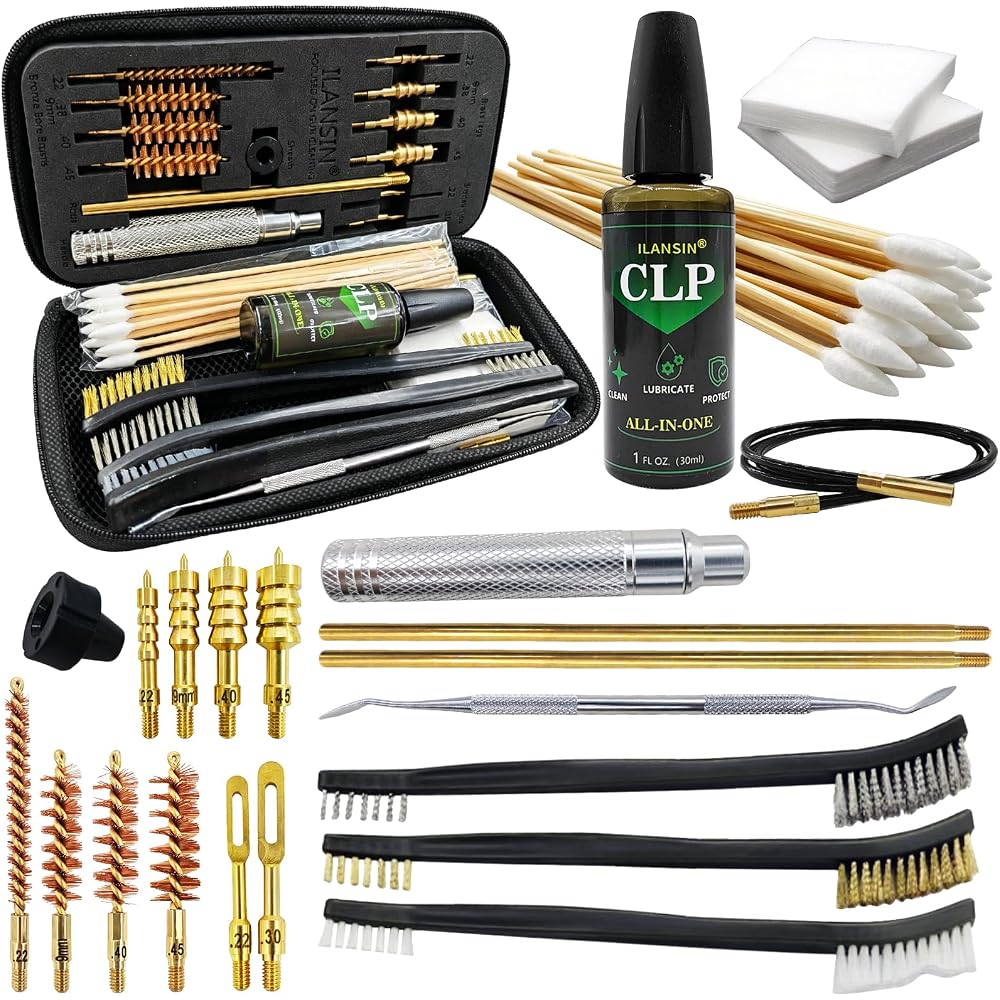
A caliber-matched rod, jag and brush set — the tools the manuals assume you already have.
A practical cleaning schedule
The table below turns those conditions into decisions. The right-hand column names the consumable that does the work: patches, CLP and cloths get reordered constantly, while the rod and jag are bought once.
| How you use the firearm | What the manuals add up to | Tool |
|---|---|---|
| Range pistol or rifle, a few hundred rounds per trip | Inspect and wipe down after every session; a full solvent clean is not mandatory every outing on a modern pistol — SIG SAUER sets the floor at 500 rounds. | 9mm kit |
| Defensive / everyday-carry handgun | Inspect weekly, wipe the exterior, and clean plus re-lubricate at least monthly even in a quiet month — GLOCK publishes a monthly floor for pistols that have not been used. | CLP |
| Hunting rifle or shotgun | After every outing, fired or not. Dust, rain, sweat and vegetation do more damage than a handful of rounds. | Silicone cloth |
| Rimfire (.22 LR) | Same after-use routine, but brush the bore sooner: rimfire wax and lead-lubricant residue builds faster than centerfire fouling. | Patches |
| High-volume practice or competition | Every session, or 500 rounds at the outside — and immediately if accuracy or feeding changes. | Bore snake kit |
| Any firearm going into storage (3+ months) | Clean, lightly oil, store dry and unloaded, then re-inspect every three to six months. Humidity corrodes steel; round count does not. | Cleaning mat |
| Corrosive-primer surplus ammunition | Clean the same day. The salts corrosive primers leave pull moisture into the bore and can pit steel within days. | CLP |
| Rain, snow, sweat, salt air or submersion | Not a schedule question — clean and dry it now. "Later this week" is the wrong answer. | CLP |
Three triggers that override any schedule
Moisture beats round count. A firearm that sat in a humid case all summer unfired is a higher rust risk than one that fired 300 rounds in dry indoor air — water, salt air and sweat attack steel and blued finishes, which is why every manual above lists environmental exposure alongside live fire.
Corrosive ammunition. With corrosive-primer surplus, the clock starts at hours rather than weeks: those residues are hygroscopic, pulling moisture out of the air onto the metal. Clean the same day with a water-based or dedicated cleaner, dry completely, then apply a light protective film.
Storage is a cleaning task too. Before a firearm goes away for months, clean it, oil it lightly, and confirm the storage spot is genuinely dry — foam-lined cases and leather holsters hold moisture against metal. SAAMI's ammunition guidance makes the same point about the environment: ammunition should be "stored in a cool, dry location away from solvents and other chemicals, heat sources, or open flames."
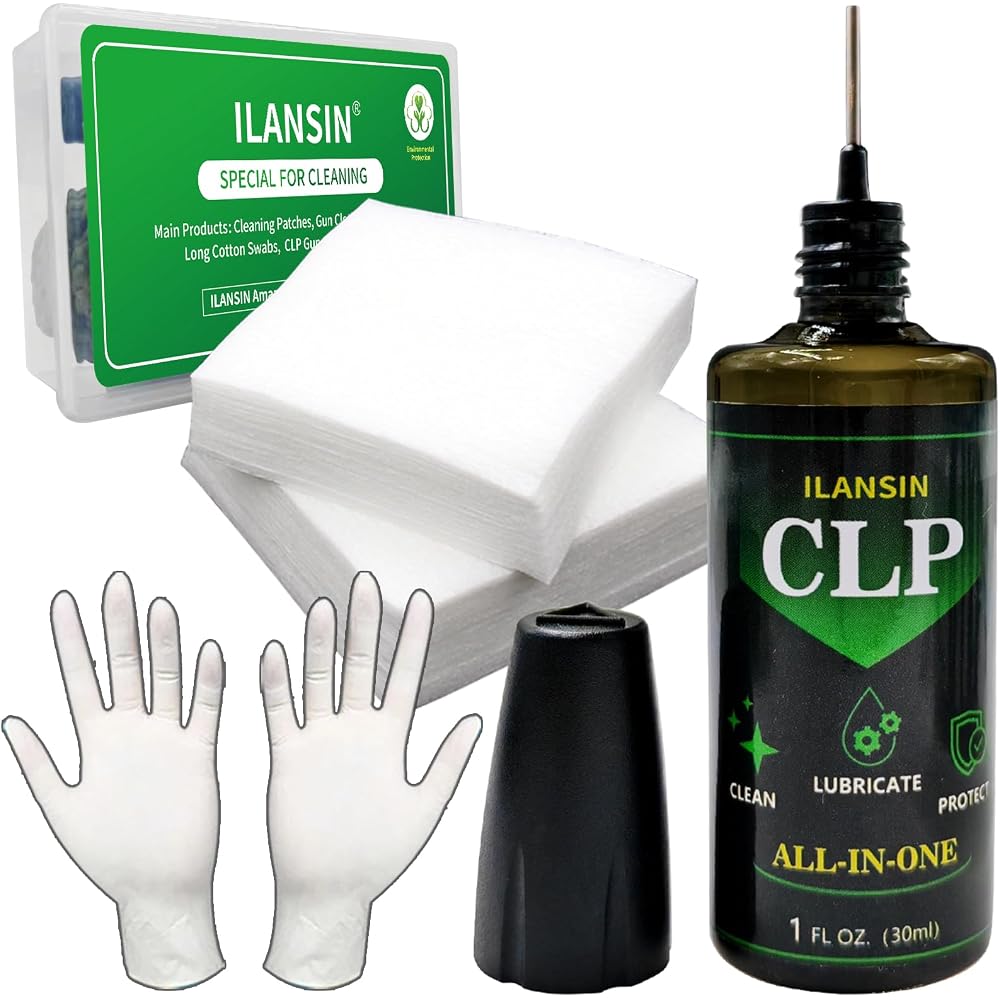
Clean, lubricate and protect in one bottle — the step you repeat every session.
Do not over-clean either
Every manual warns about the same two mistakes. Ruger puts the first one bluntly — "Use correct size patches and brushes. Larger sizes will bind in the bore" — and adds that excess oil "tend[s] to attract particles of dust and dirt and may congeal in cold weather." So: match the patch and brush to the caliber, push the rod through in one direction instead of scrubbing back and forth over the crown, keep solvent off wood and some polymer finishes, and leave the bore dry before firing.
A 15-minute after-range routine
- Clear the firearm and keep live ammunition off the bench entirely.
- Wipe the exterior with a lightly oiled or silicone-treated cloth — handling sweat is already working on the finish.
- Run a solvent-wetted patch through the bore from the chamber end, then the correctly sized brush, then dry patches until they come out clean.
- Re-lubricate only the points your manual names, and sparingly. More oil is not more protection.
- Function-check the empty firearm and note what you did — the note is what turns maintenance into an actual schedule.
Pulling in one direction from the chamber end also keeps a brush from jamming; the trade-off between pull-through and rod is covered in our comparison of bore snakes and cleaning rods. Assembling a first kit? Start with the beginner's first-clean walkthrough and the explainer on what CLP actually does.

Silicone-treated cloths handle the wipe-down step most cleaning schedules forget.
What to keep on the bench
Almost everything here is a consumable you will reorder: bulk 100% cotton patches, a bottle of CLP with a needle applicator, and silicone-treated cloths. The durable side is smaller — a caliber-matched 9mm pistol kit, a bore snake set for quick passes after a light session, and a cleaning mat so pins and springs stay on the bench instead of the floor. Buy consumables in bulk and the cost per clean drops to almost nothing.
Buying for a store, a range or your own brand?
Everything above is manufactured on our own line and available wholesale — mixed-SKU cartons, private label from 500 pcs, and single-unit samples on Amazon if you want to test the product first.
Wholesale & Distribution →OEM / ODM →
Or order a single sample to see the quality first.
Sources
- GLOCK — Caring for Your GLOCK (cleaning and lubrication schedule): us.glock.com
- GLOCK — Safe Action Pistols instructions for use, G17–G48 (maintenance intervals, field stripping, lubrication points): eu.glock.com (PDF)
- SIG SAUER — P320 operator's manual (500-round / every-day-fired interval): sigsauer.com (PDF)
- Ruger — LCP MAX and AR-556 owner's manuals (after-range and adverse-condition cleaning; bore brush sizing): ruger.com (LCP MAX) · ruger.com (AR-556)
- Ruger — No. 1 rifle manual (no fixed cleaning interval; rod technique): ruger-docs (PDF)
- SAAMI — Recommendations for Safe Ammunition Storage and Handling: saami.org
- CDC / NIOSH — Preventing Occupational Exposures to Lead and Noise at Indoor Firing Ranges (gloves and eye protection, wash-up): cdc.gov/niosh
Manufacturer guidance is quoted briefly and attributed above; the schedule wording is our own summary. Always follow the owner's manual for your specific firearm. Cleaning chemicals and lead residue require ventilation, gloves and eye protection — wash up before eating, drinking or handling food.