
5.56mm / .223 Bore Cleaning: What AR-15 Owners Need
The AR-15 is the most-owned rifle platform in the United States, and few barrels see the round counts a 5.56mm or .223 upper sees. The platform adds a second cleaning problem on top of the usual bore fouling: its direct-impingement gas system vents combustion gas straight back into the bolt carrier, baking carbon onto parts a bolt-action owner never has to think about. None of it is difficult — but the order matters, and the cartridge itself sets two rules worth knowing first.
The cartridge and chamber set the rules
SAAMI — the Sporting Arms and Ammunition Manufacturers' Institute, which has standardized US cartridges since 1926 — lists the .223 Remington at a maximum average pressure of 55,000 psi. In June 2026 it published a commercial 5.56 Commercial standard at 62,000 psi. The two rounds share outside dimensions but not chambers: the .223 Remington throat (leade) is typically about .085 inch, the 5.56 chamber's about .162 inch, and firing the hotter military-spec round in a short .223 throat spikes pressure. SAAMI's published guidance is unambiguous: "it is not safe to shoot '5.56,' '5.56 NATO,' or '5.56x45mm' ammunition in a barrel marked as being chambered in 223 Remington." The new standard's compatibility notice says ammunition made to the 5.56 specification in a .223 Remington chamber "creates increased pressure and is considered an unsafe combination."
For cleaning, two consequences follow. Ammunition choice belongs to your barrel's roll mark and your manual — not to what happens to chamber smoothly. And the bore dimensions are why every tool for this caliber is sold as .22 caliber / 5.56mm: SAAMI's drawings give .219-inch lands, .224-inch grooves, and the .224 bullet riding the grooves.
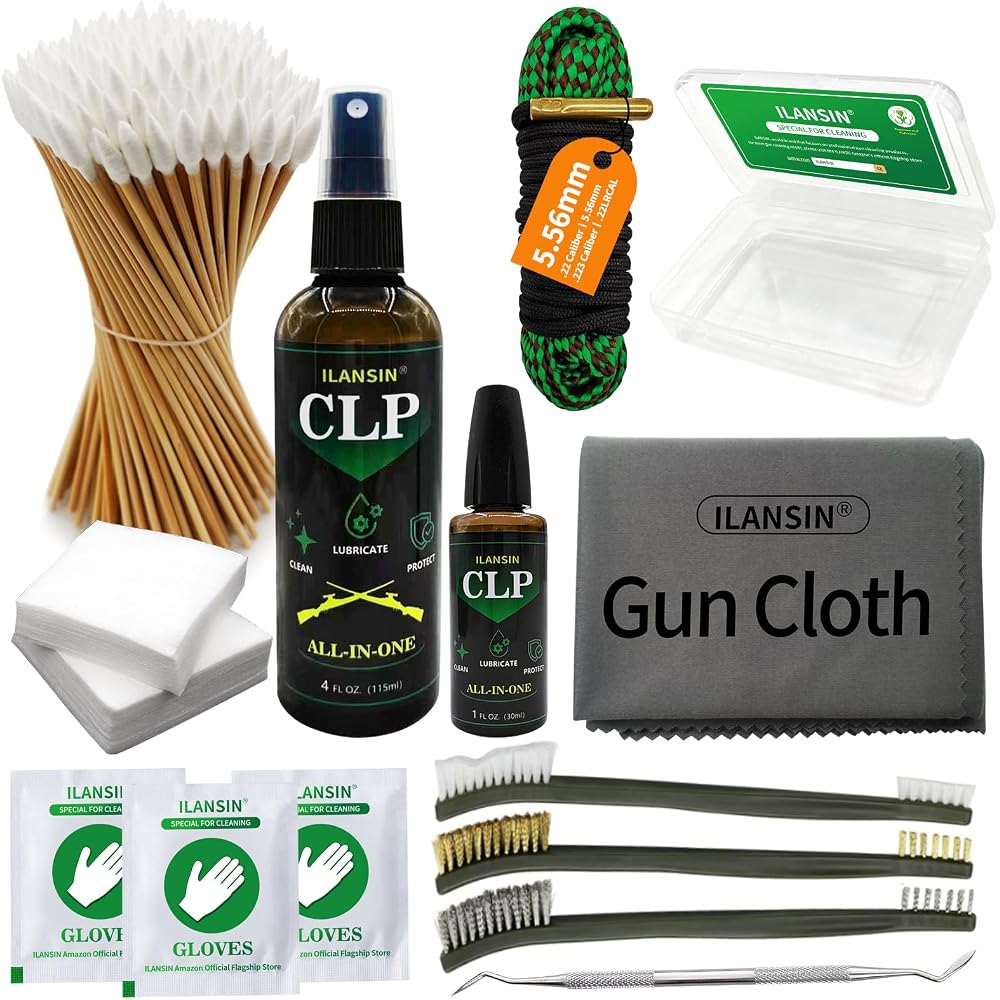
A caliber-matched kit: the bore snake and brushes are sized .22 Cal / 5.6mm / .223, so nothing binds in the bore.
What the AR-15 adds that a bolt gun does not
Every shot sends hot gas through the gas tube into the bolt carrier, so carbon lands on the bolt tail, gas key, bolt face and inside the carrier — layered and heat-hardened, not the loose powder a wipe removes. Ruger's AR-556 manual keeps the disassembly limits clear: "The handguard and gas block should not be removed for cleaning or maintenance." Field strip as the manual describes, and every part that needs solvent is reachable. The same manual names the two costs of fouling: bore fouling degrades accuracy, and residue in the chamber interferes with feeding.
The routine, step by step
- Clear it, then field strip. Remove the magazine, lock the bolt back and look into the chamber twice. Split upper from lower and take out the bolt carrier group and charging handle — that is all the disassembly a routine cleaning needs.
- Wet the bore from the chamber end. Run a solvent-wetted .22-caliber brush the full length of the bore and out the muzzle, one direction. Ruger begins its AR-556 procedure gently, with dry patches first: "Clean the bore with dry patches and examine."
- Brush, then patch until clean. Six to ten wet brush passes, then push cotton patches through one at a time until they come out light gray instead of black. Green or blue staining means dissolved copper — a copper-solvent pass takes care of it.
- Scrub the chamber and throat. A chamber brush, worked in the direction that tightens it, lifts the carbon ring patches never reach. The throat runs hottest in a semi-auto — give it a wet brush pass too.
- Attack the bolt carrier carbon. This is the AR-specific work: bolt tail, bolt face, gas key, cam pin and the inside of the carrier all collect baked-on carbon. Nylon brush and solvent on the carrier, pointed swabs in the bolt tail and gas-key recesses. It does not have to be spotless.
- Wipe the upper receiver. Carbon and unburned powder collect under the gas tube and in the charging-handle channel. Solvent on a patch, then dry.
- Lubricate lightly. A film on the bolt, cam pin and carrier rails is enough. Ruger is explicit: "Only a light application of oil is needed to provide adequate lubrication of moving parts and to prevent rust." Excess oil in a direct-impingement gun ends up baked into next session's carbon.
- Reassemble and function-check. Cycle the action on an empty chamber, confirm the safety and trigger reset, then wipe the exterior with a silicone-treated cloth.
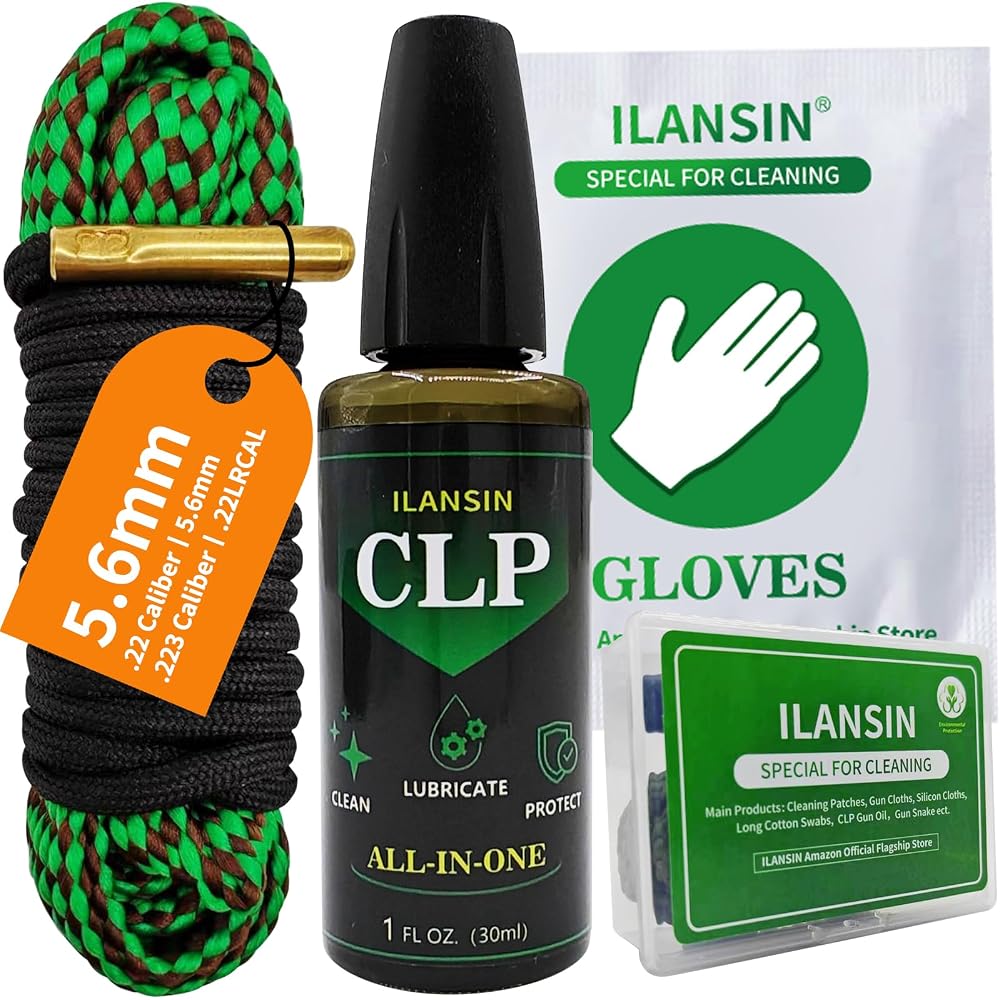
Bore snake for the range-bag pass, CLP with a needle applicator for the carrier and rails.
Copper fouling and chrome-lined bores
Many 5.56 barrels are chrome-lined — harder, easier to wipe clean — but copper jacket material still deposits down the bore at 3,000-plus feet per second. Blue-green staining on your patches means copper is coming out; a copper-solvent pass every few sessions is plenty. A faint gray tint is normal, and brushing far past the point of clean patches does nothing for accuracy while it wears the brush and the crown.
Lead and solvent safety
Rifle cleaning carries the same lead-exposure rules as pistol cleaning: primer and bullet lead collects in the bore and on patches. Do not eat, drink or smoke while you work, ventilate the room, wear glasses and gloves, and wash hands and face afterwards — the CDC/NIOSH guidance for shooters covers the hygiene basics. If you are new to the process, the beginner's first-clean walkthrough covers the safety setup in detail.
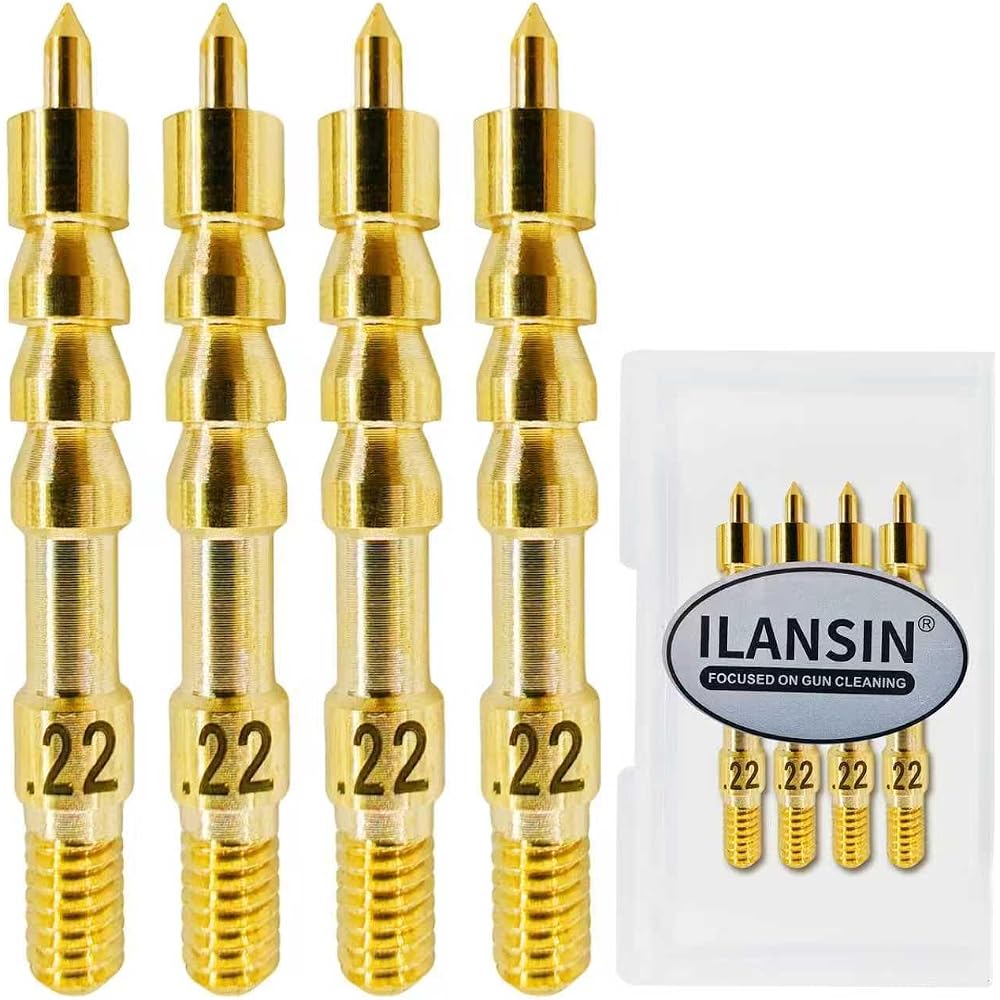
A correctly sized brass jag centers the patch so it wipes the whole bore, lands included.
What to keep on the bench
The consumables are what you reorder: bulk 100% cotton patches in the .22-caliber size, CLP with a needle applicator for the bolt carrier and rails, and a cleaning mat to keep small parts on the bench. The caliber-specific tools do the rest — a 5.56mm / .223 cleaning kit bundling snake, brushes and CLP, a dedicated .22 cal / 5.56mm bore cleaner and snake, and .22-caliber brass jags in 4-packs (or 10-packs for high-volume shooters) on 8-32 threads. To decide how often the routine repeats, our cleaning schedule by use case lays out manufacturer intervals.
Buying for a store, a range or your own brand?
Every product above is manufactured on our own line and available wholesale — mixed-SKU cartons, private label from 500 pcs, and single-unit samples on Amazon if you want to test the product first.
Wholesale & Distribution →OEM / ODM →
Or order a single sample to see the quality first.
Sources
- SAAMI — FAQ on .223 Remington / 5.56 interchangeability (unsafe combination warning): saami.org/faqs
- SAAMI — 5.56 Commercial cartridge & chamber standard, public introduction and compatibility notice (June 2026; MAP 62,000 psi): saami.org (PDF)
- SAAMI — .223 Remington cartridge & chamber drawings (55,000 psi; .219 lands / .224 grooves): saami.org
- Federal / Vista Outdoor — technical bulletin "The Difference Between 223 Rem and 5.56 Military Cartridges" (leade .085" vs .162"): le.vistaoutdoor.com (PDF)
- Ruger — Instruction Manual for Ruger AR-556 Autoloading Rifle (calibers .223 Rem / 5.56 NATO; cleaning sequence, handguard and gas block limits, lubrication note): ruger.com
- CDC / NIOSH — Preventing Occupational Exposures to Lead and Noise at Indoor Firing Ranges (hygiene, gloves, ventilation): cdc.gov/niosh
Manufacturer and standards guidance is quoted briefly and attributed above; the step-by-step wording is our own summary. Ammunition compatibility is decided by your firearm's manufacturer and roll mark, not by this article. Always follow the owner's manual for your specific rifle. Cleaning chemicals and lead residue require ventilation, gloves and eye protection — wash up before eating, drinking or handling food.