
.22 LR Fouling: Why Rimfire Barrels Need Different Care
No cartridge gets fired more than the .22 Long Rifle — plinking, training, small game, suppressed range sessions. And few get cleaned wrong more often, in both directions. Some owners scrub the bore after every brick of ammo like a match rifle; others follow the old range myth that rimfires never need cleaning at all. Both camps miss the same fact: a .22 bore does not foul like a centerfire bore. It collects soft lead and bullet wax instead of copper jacket, the schedule is different, and even the direction you run a rod matters more. Here is what actually builds up in a rimfire barrel, and a routine that matches it.
What actually builds up in a .22 bore
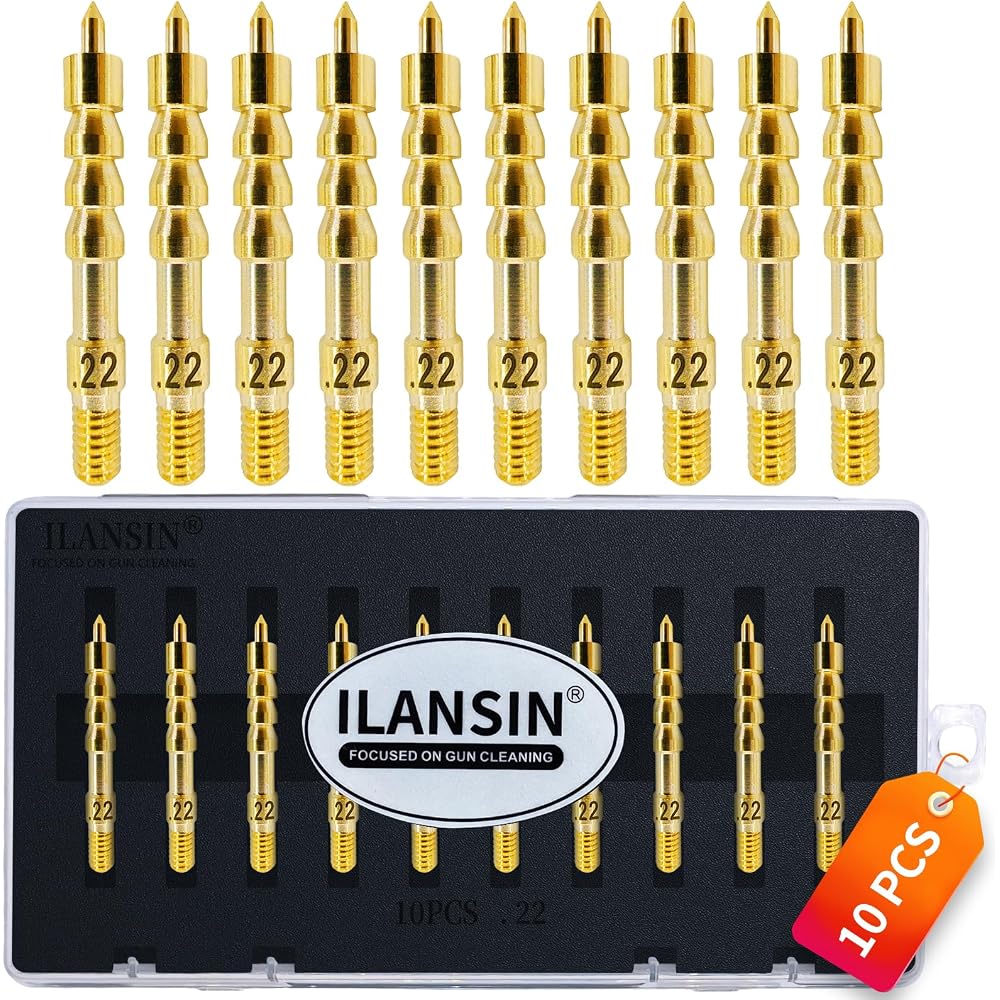
A .22-caliber brass jag is the workhorse tool for rimfire fouling, which is lead and wax rather than copper.
Centerfire fouling is mostly carbon and copper from jacketed bullets. Rimfire fouling has four separate contributors, as shooting writer George Harris laid out in Shooting Illustrated: the wax lubricant coated on nearly every .22 bullet, the soft lead projectile itself (even copper-washed rounds leave lead), burned and unburned powder, and the priming compound, which is abrasive and among the hardest residue to remove. The result looks different on the patch, too — grey streaks in the rifling after a few hundred rounds are lead smear, and they are normal, not a crisis.
The practical consequence: centerfire-style solvent routines are the wrong fit. A rimfire bore needs mechanical patch work, a brush used sparingly, and focus on the two places where fouling causes real failures — the chamber and the action.
The chamber ring: a rimfire signature problem
The most consequential .22 fouling is not spread down the bore; it sits just ahead of the case mouth. Harris again: "It is thought the residuals from the primer, powder and projectile-lubricant amalgamate at the cartridge seat where the chamber ends and the throat begins." On a rimfire the ring matters more than anywhere else: a rimfire cartridge headspaces on the case rim, so buildup that keeps a round from fully seating can push the pressure curve — Harris treats the bulged case rims many shooters notice as a classic symptom of exactly this.
The manufacturers agree on the feeding side. The official Ruger 10/22 instruction manual notes: "Bore fouling can contribute to reduced accuracy, and grease accumulation in the chamber can interfere with proper feeding of cartridges from the magazine." In other words, neglect in a semi-auto .22 shows up first as failures to feed, not as lost accuracy. A dedicated .22-caliber bore cleaner with CLP applied at the chamber, worked with a nylon brush in short strokes, is the right tool for this zone — aggressive full-length brushing is not.
How often: less than you think

A .22 bore cleaner paired with a CLP needle oiler covers both the chamber ring and the light protective film rimfire bores prefer.
Here rimfire advice flips completely. Precision barrel maker Lilja Rifle Barrels states that rimfire barrels need very little cleaning and essentially no break-in, and recommends: a dry loose patch through the bore roughly every 100 rounds, and a solvent-wetted (worn) bronze brush worked in short strokes in the leade area every 200–300 rounds — full-length scrubbing only when lead is actually visible.
There is a reason to hold back. Match-grade .22 ammunition relies on its wax coating conditioning the bore, and as Lilja puts it, "using solvents will only remove this desirable wax coating." A freshly scrubbed rimfire bore often needs several rounds to settle before groups tighten; Harris observed accuracy typically drifting off around 100–150 rounds on his match guns, then recovering after a proper clean. So the honest schedule is:
- Pull a dry patch after sessions; deep-clean on round count (200–500 is a sane band for plinking ammo) or when groups open up — see our practical cleaning schedule.
- Always clean before long storage and after any old or unknown ammunition.
- Never judge a .22 bore by centerfire standards — grey lead streaks are normal; a chamber ring and feeding failures are not.
The direction problem: muzzles, crowns and tube magazines
Most centerfire rifles clean from the breech. Many .22s cannot — tube-fed autoloaders and a large share of bolt guns give no access to the chamber end with a rod. Owners end up working from the muzzle, which puts the crown — the last machined edge the bullet touches — at risk from a rigid steel rod. The safe options: a flexible pull-through that does not bear on the crown (compare the trade-offs in our bore snake vs rod guide), or a one-piece rod centered by a muzzle guide. What ruins old .22s is a bare jointed rod rattling in and out of the muzzle for years — one of the classic entries in our cleaning mistakes list.
Suppressed rimfires add one more interval: the added back-pressure pushes more residue back toward the chamber, so both the bore threads and the ring zone need checking more often — we cover that routine separately in the suppressed .22 cleaning guide.
A practical .22 routine

Bulk cotton patches do most of the work in a rimfire bore — mechanical patch passes, not harsh scrubbing.
- Unload and verify — magazine out, chamber checked, bolt open. This step is the whole safety case for rimfire cleaning.
- Chamber first — solvent on the ring zone, nylon brush in short strokes, then patches until they come back clean.
- Bore on schedule — wet patch, brush only when fouling demands it, dry patch to finish. Stop judging by centerfire shine.
- Action details — dried wax packs into extractor recesses and tube magazines and jams feeding; the SSAA maintenance guide documents exactly this failure path. A pointed swab clears the slots safely.
- Oil like the manual says — Ruger’s 10/22 manual warns that excess oil attracts dust and can congeal in cold weather and interfere with function. One light film is enough.
- Wash hands after handling fouled parts — rimfire residue is lead-rich, and basic lead hygiene (no snacking at the bench, wash up afterwards) is standard CDC/NIOSH guidance.
What this means for wholesale buyers
Rimfire is the entry segment, which makes it a volume play: first guns, first cleaning kits, high units and steady reorder. The .22-specific SKUs that pull the line together are caliber-marked 10-piece .22 jag sets and compact 4-piece versions for starter kits, the .22 bore cleaner + CLP pairing for the chamber-ring job, and bulk 1,500-count patches — the consumable rimfire owners burn through fastest. A caliber-marked starter kit rounds out the shelf. The same logic works for a private-label lineup — our OEM/ODM program configures kits, caliber markings and packaging from negotiable MOQs.
Stocking rimfire care for your market?
We manufacture the full line in our own plant since 1980 — jags, patches, bore care, cloths and CLP — with OEM/private label from negotiable MOQs per SKU.
Request a Wholesale Quote →OEM / ODM →
Or order a single sample on Amazon to test the line before you commit volume.
Sources
- Ruger 10/22 Autoloading Rifle Instruction Manual (PDF) — "Bore fouling can contribute to reduced accuracy, and grease accumulation in the chamber can interfere with proper feeding of cartridges from the magazine."; excess-oil caution (attracts dust, may congeal in cold weather): ruger.com
- Lilja Rifle Barrels — 22 Rimfire Maintenance (dry patch ~100 rounds; worn bronze brush with solvent in the leade every 200–300 rounds; match wax coating quote): riflebarrels.com
- George Harris, "Should You Clean Your .22 LR?", Shooting Illustrated (2016) — four fouling factors; chamber/throat ring quote; bulged-rim symptom; accuracy drift around 100–150 rounds: shootingillustrated.com
- SSAA (Sporting Shooters’ Association of Australia), "Keep it clean!" — wax/grease deposits in extractor recesses and magazines causing extraction and feeding failures: ssaa.org.au
- CDC/NIOSH lead-exposure precautions (hand hygiene after handling fouled firearms) — as cited in our earlier cleaning guides: cdc.gov/niosh
Manufacturer guidance is quoted briefly and attributed above; interval recommendations and B2B notes are our own summary as a cleaning-tools manufacturer. Always follow the owner's manual for your specific firearm.